
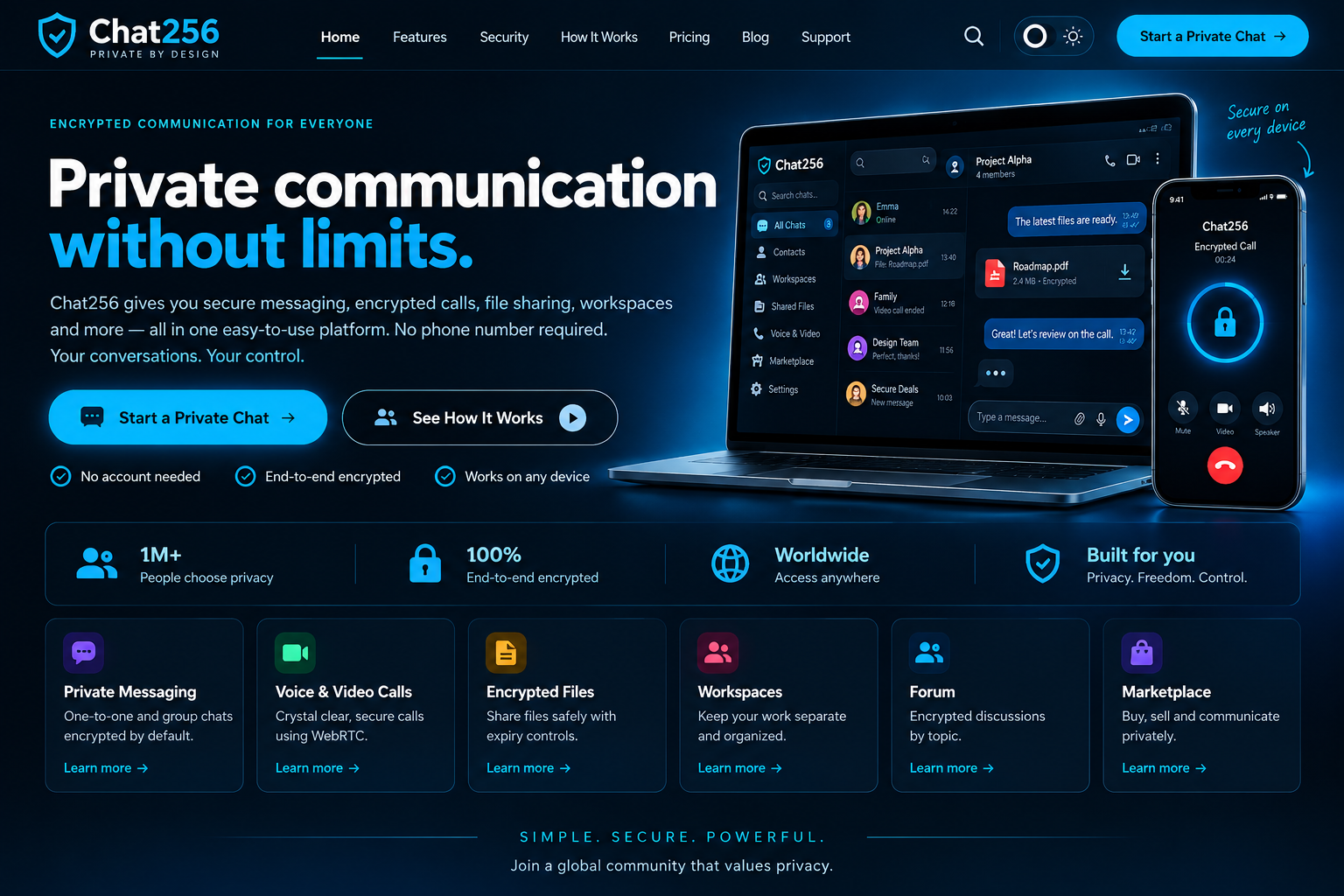
Private messaging
The core experience is a direct conversation rather than a public social profile. Users can start a conversation and invite another person without making a phone number the centre of the interaction.
Private communication should be practical, not complicated. Chat256 reduces unnecessary identity exposure while protecting supported communication with client-side encryption and authenticated service controls.
Voice and video calls
Voice and video calling uses WebRTC with authenticated signalling, encrypted signalling envelopes, ICE and TURN support. Chat256 is designed to make secure calls feel as simple as starting a conversation.
Encrypted file transfer
Encrypted file transfer supports client-side protection, chunked uploads, progress, expiry, quotas and dedicated storage controls. Workspace keeps working files separate from the ordinary conversation stream.
Disappearing messages and direct invitations
Supported messages can use expiry controls. Direct invitations can use QR codes, private links or chat keys, reducing the need to exchange personal contact details for a short-lived conversation.
Workspace
Workspace is intended for files that should remain distinct from the conversation stream. Workspace uploads are kept separate from ordinary chat publication, so working files do not need to appear in the main conversation stream.
Forum
Forum brings encrypted community discussions into the same privacy-focused platform, with organised sections, threads, posts, reactions and community controls.
Marketplace
Marketplace gives buyers and sellers a private place to communicate, discuss products and coordinate transactions. Payment protection, delivery and seller verification remain separate commercial arrangements and should be agreed between the parties.
Billing
Plans and entitlements let Chat256 scale from lightweight communication to higher storage and Workspace requirements. Account limits and purchased features are managed through the service.
Security engineered into the platform
Chat256 is built around client-side cryptography, authenticated identities, secure transport and controlled access to protected data. Supported private messaging uses ECDH P-256, HKDF-SHA256 and AES-256-GCM, while authenticated sessions and server-side controls protect the service around the encrypted payload.
The result is a communication platform designed to make privacy practical: protect supported content, minimise unnecessary identity exposure and give users clear controls over sessions, files and expiry.
Private messaging, step by step
The messaging layer is designed around encrypted payloads rather than storing readable message text on the server. A typical conversation begins with an authenticated identity and session, establishes the required cryptographic material in the browser, and then sends protected message envelopes through the service.
- Identity: the browser maintains the cryptographic identity used by supported account and messaging flows.
- Authentication: durable sessions are checked for validity, expiry and identity consistency.
- Encryption: supported private messages use ECDH P-256 key agreement, HKDF-SHA256 key derivation and AES-256-GCM authenticated encryption.
- Transport: HTTPS/WSS protects the connection between the browser and service.
- Cleanup: supported private-message retention is subject to server-side TTL controls.
Encryption does not remove recipient risk: someone who can read a message can still photograph, copy or otherwise preserve it.
Identity, contacts and notifications
Chat256 also provides identity-aware private contacts. Contact data can be held in protected browser storage, while private polling uses authenticated proof tied to the active identity and session. Browser notifications are deliberately generic so message contents are not copied into operating-system notification text.
Files, media and voice notes
Supported attachments use the same privacy-first principle: encryption is performed on the client before transfer, with chunking for larger data, authenticated transfer controls, progress handling, expiry and deletion. Voice notes are handled as encrypted media rather than ordinary readable chat attachments.
Security assurance
Chat256 brings privacy into the everyday communication workflow: protected messaging, private invitations, encrypted files, disappearing content, calls, identity controls and dedicated Workspace tools. Users remain in control of their devices, credentials, recovery material and who they invite.